
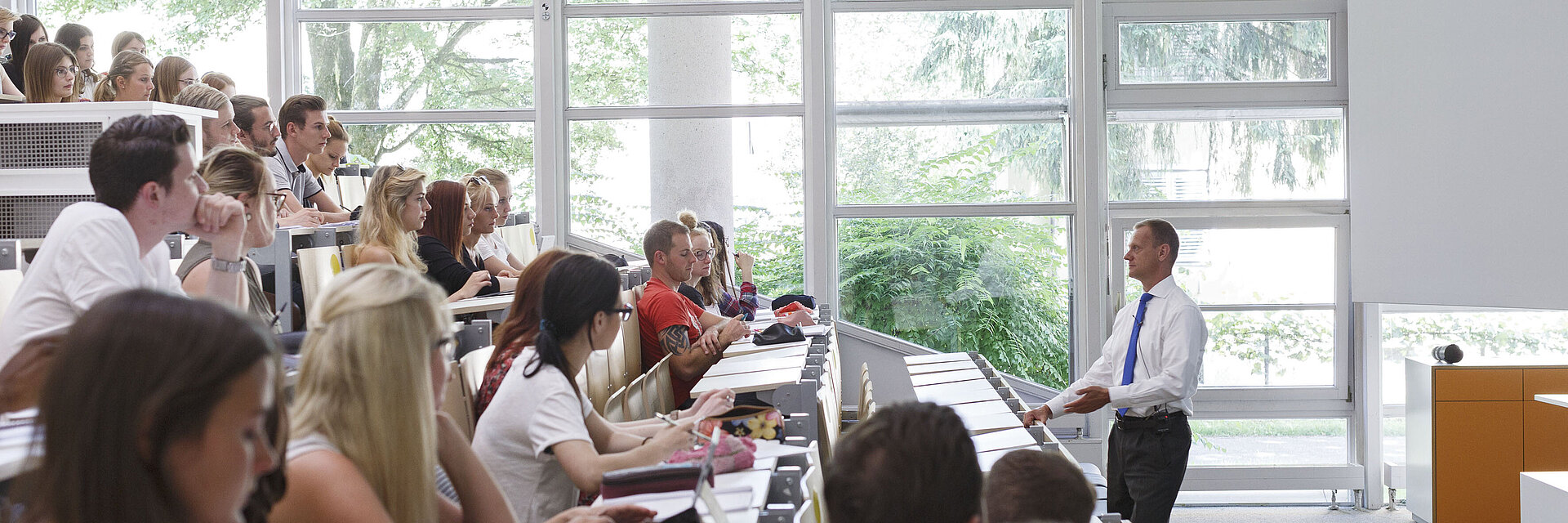

Sustainability in Teaching and Professional Development
Mission Statement for Teaching and Learning
ACTING SUSTAINABLY - We create a framework that combines sustainable knowledge, personal development and health, and puts people at the centre.
Strategic objectives
- Promoting sustainability skills and teaching content to help shape a sustainable future in a responsible manner
- Empowering students to shape a sustainable future
- Supporting teachers (and multipliers) in further developing their understanding of sustainability
- Health and wellbeing as the foundation for sustainable teaching and learning

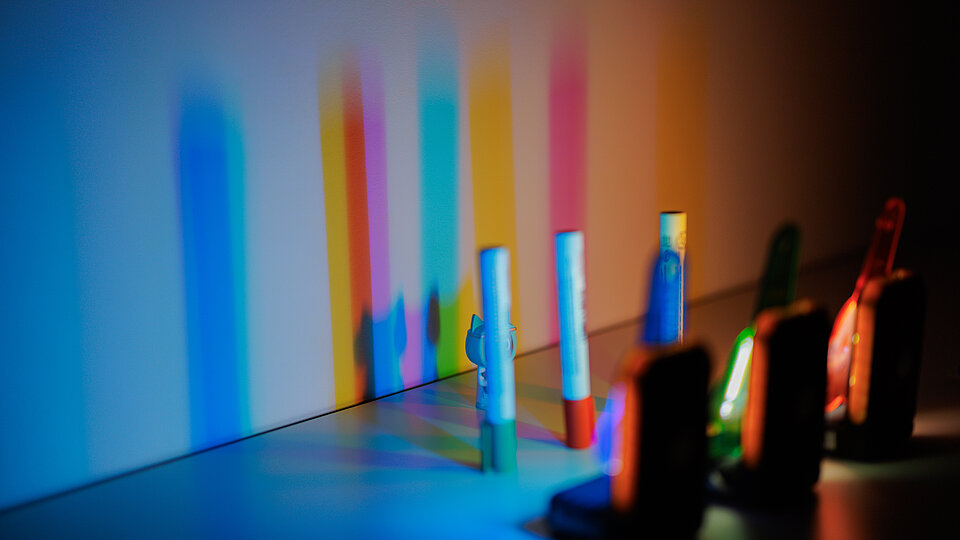
Laboratory E (STEM Education)
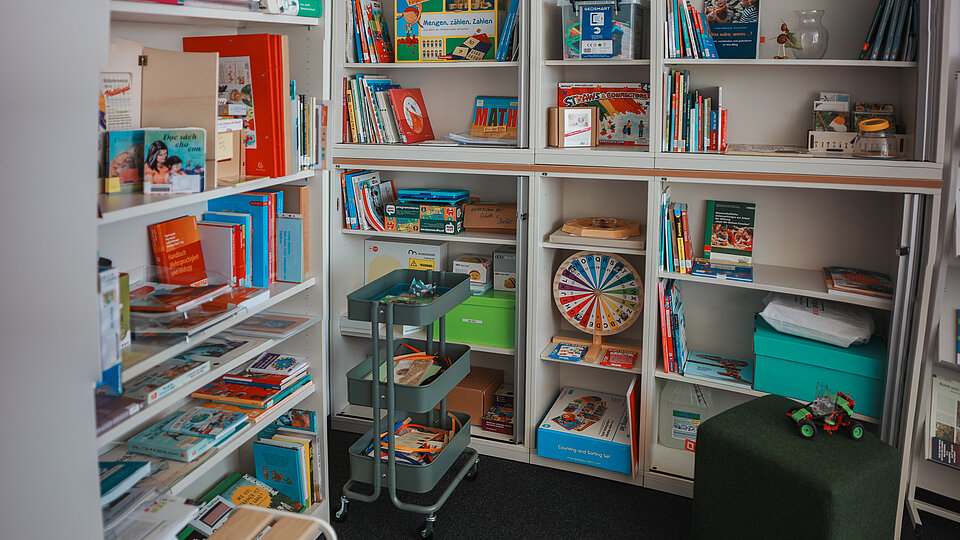
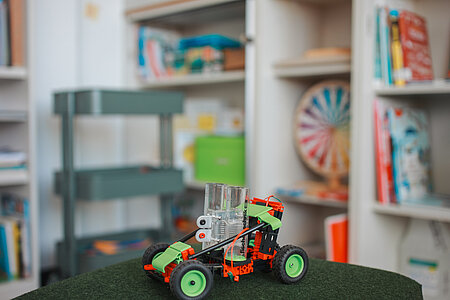
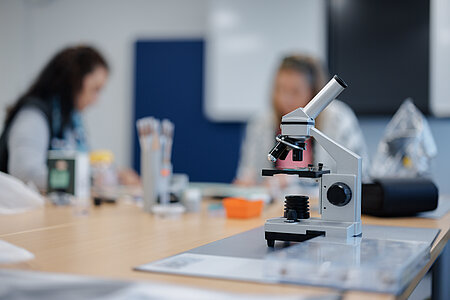
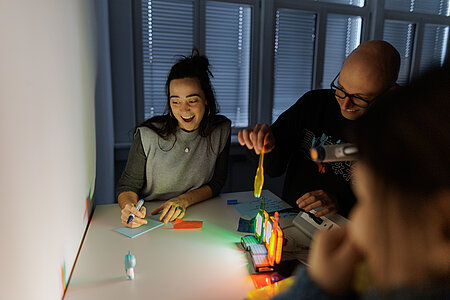
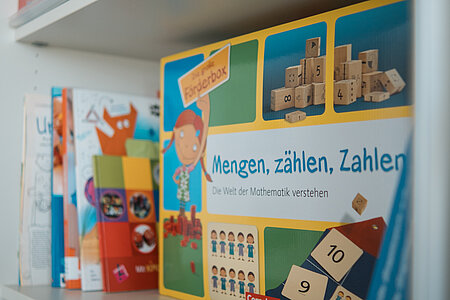
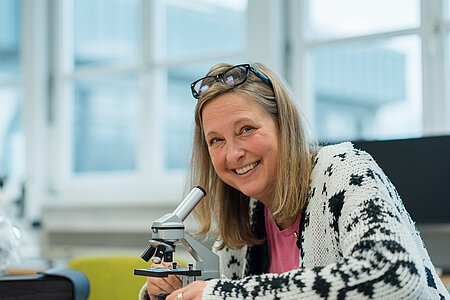
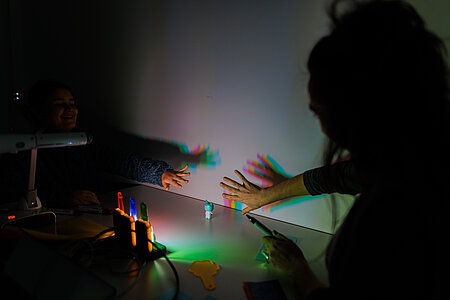
The laboratories of the Faculty of Social Sciences at the Mühldorf am Inn campus: The laboratories of the Faculty of Social Sciences at the Mühldorf am Inn campus offer students numerous opportunities to put their theoretical knowledge into practice. Lecturers use the resources for a wide variety of teaching methods in seminar-based classes. The campus is also home to Laboratory E, a facility dedicated to education for sustainable development, which forms a cross-cutting theme in the STEM education modules of the Early Childhood Education degree programme. The full catalogue of available resources and rooms can be viewed on the Learning Campus.
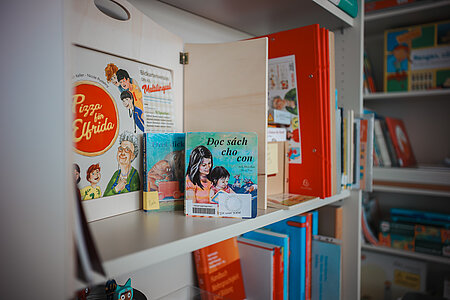
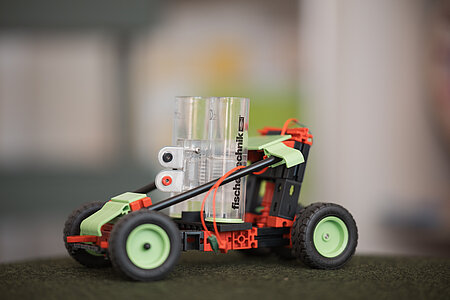
The leihBar – a living example of a sharing culture on campus
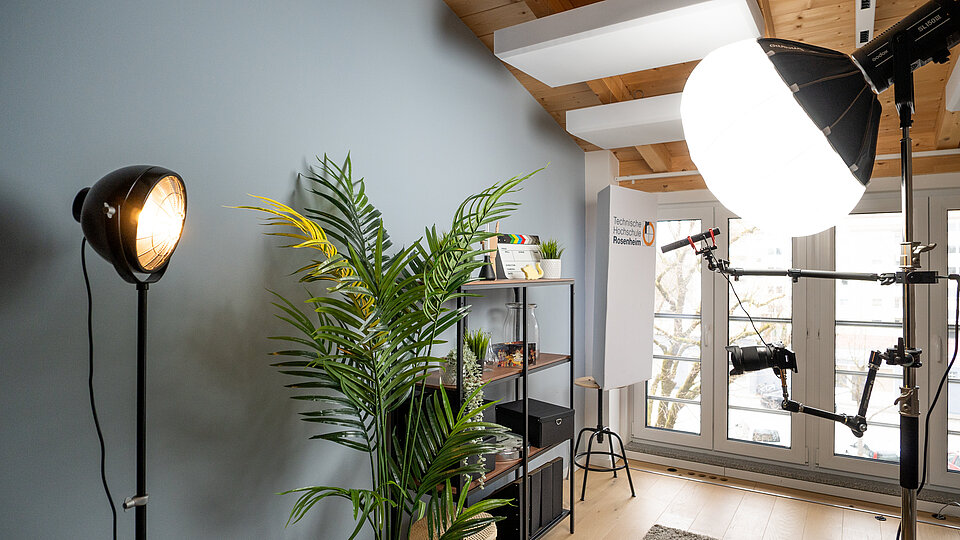
The E-Learning Centre offers not only media technology but also facilities, including an acoustically optimised video and podcast studio. Availability can be checked online via the TH Rosenheim dashboard (on the university’s intranet, accessible only to members of the university community), and the required equipment can be booked directly.
You can find more information here.
Good Practice – Laboratory for Agile and Hybrid Teaching at Rosenheim University of Applied Sciences
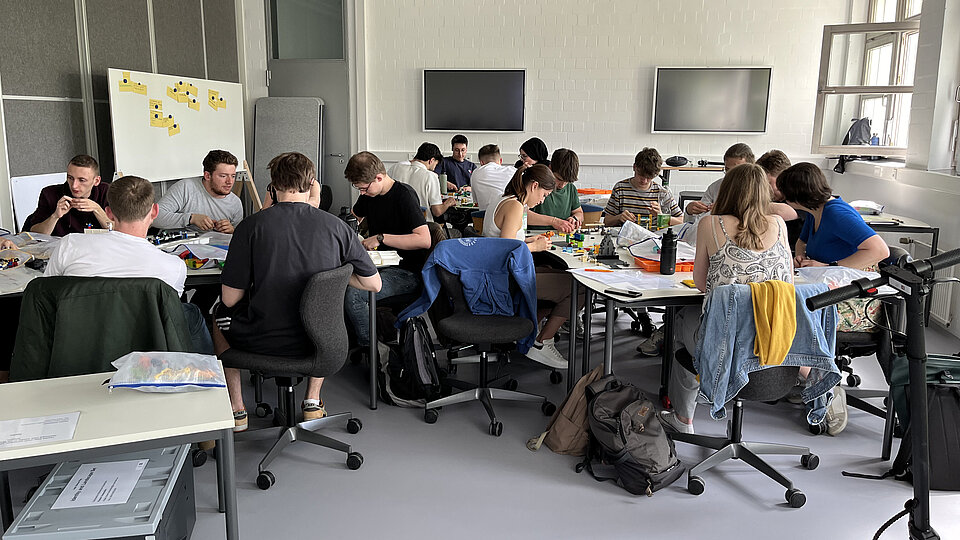
The imparting of specialist knowledge in lectures goes hand in hand with solving practical problems through student group work, which enables theoretical knowledge to be immediately applied in practice and thus consolidated. To enhance the individual learning success of its students, the Faculty of Management and Engineering at TH Rosenheim relies on problem-based and flexible teaching methods. To this end, the faculty has established the Laboratory for Agile and Hybrid Teaching, comprising two rooms whose facilities meet a variety of teaching requirements.
In one room, for example, an agile teaching and learning environment has been created, for which mobile furniture was specially developed and produced in-house in the university’s timber construction laboratories; this allows mini PCs running specific software for courses to be integrated via folding mechanisms as required, or ‘hidden away’ when free workspace is needed.
Another room offers a flexible infrastructure for hybrid group work and lectures. It features, on the one hand, high tables, room dividers and a seating area for creative group work, and, on the other hand, interactive taskboards and whiteboards for the virtual integration of experts and remote students, facilitating in-depth discussion.
During the lightning talk, the functionality of both rooms will be explained using a number of specific teaching and learning scenarios – ranging from traditional knowledge transfer in lectures, through agile group work techniques, to the active involvement of experts and students working remotely.
Good Practice – ‘WI-Story’ – A comprehensive company history as part of the Bachelor’s degree programme
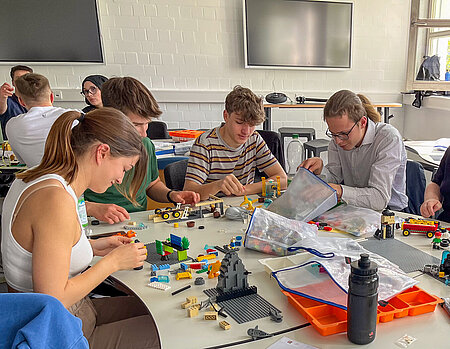
Since 2024, teaching on the Bachelor’s degree programme in Industrial Engineering at TH Rosenheim has been based on an innovative teaching and learning concept. The so-called ‘WI-Story’ integrates practical and solution-oriented methods designed to enable students to engage more deeply with the course content and to boost their motivation. The concept was developed and refined as part of the university-wide HigHRoQ project, with support from the project team at the Faculty of Industrial Engineering. It was funded by the ‘Innovation in Higher Education’ Foundation.
A fictional company as an illustrative example
The WI-Story is based on the pedagogical concept of Problem-Based Learning (PBL) and context-based learning, and adopts a student-centred approach. At the heart of the new concept is a fictional company that manufactures e-scooters. This company serves as a common thread running through the various modules of the degree programme. Lectures and seminars are supplemented by questions and problems posed by the company, making the teaching more tangible and practical. This enables students to apply the theoretical content directly to practical scenarios and gain a better understanding of its relevance to real-world business practice.
Identifying and understanding interfaces within a company
The WI-Story programme begins with a workshop in which students use the LEGO® SERIOUS PLAY® method to grasp the interrelationships and interfaces between the individual study modules, as well as their necessity within a real-world company. This interactive and creative method enables students to grasp complex concepts in a playful way through building and modelling with LEGO bricks. It also promotes teamwork and provides an ideal introduction to the degree programme.
For further information on the ‘WI-Story’, please contact Gretel Huber, who holds a degree in Business Administration (FH), from the ‘Sustainable Engineering & Management’ research group.

TH Rosenheim publishes its sustainability strategy
TH Rosenheim publishes its sustainability strategy
Let's create the future of our university together!
Let's create the future of our university together!
International cooperation in the spirit of happiness
International cooperation in the spirit of happiness
Driving Sustainability: Dr Cornelie Crous reflects on teaching Sustainable Management and Reporting at Rosenheim University in Germany
Driving Sustainability: Dr Cornelie Crous reflects on teaching Sustainable Management and Reporting at Rosenheim University in Germany
Climate Change Management Team
-
Dr. Bettina Ruth-Anneser
+49 (0)8031 / 805 - 2691 bettina.ruth-anneser@th-rosenheim.de
Project details
Title: KSI: Climate Protection Management for the Implementation of the Rosenheim University of Applied Sciences’ Integrated Climate Protection Concept – Follow-up Project (KSI: Klimaschutzmanagement zur Umsetzung des integrierten Klimaschutzkonzeptes der TH Rosenheim – Anschlussvorhaben)
Duration: 1 February 2023 – 31 July 2026
Implementing body: Rosenheim Technical University of Applied Sciences – Centre for Research, Development and Transfer (Technische Hochschule Rosenheim – Zentrum für Forschung, Entwicklung und Transfer)
Funding reference: 67K14067-1
Aim and content of the project: The proposed follow-up project aims to implement the key measures from the climate protection strategy and to institutionalise climate protection management at Rosenheim Technical University of Applied Sciences.
Project sponsor: www.klimaschutz.de/kommunalrichtlinie
National Climate Protection Initiative (NKI)
Through the National Climate Protection Initiative, the German Federal Government has been initiating and funding numerous projects since 2008 that contribute to reducing greenhouse gas emissions. Its programmes and projects cover a broad spectrum of climate protection activities: from the development of long-term strategies to practical support and investment-based funding measures. This diversity ensures a wealth of good ideas. The National Climate Protection Initiative helps to embed climate protection at a local level. It benefits consumers as well as businesses, local authorities and educational institutions.