

Sustainable Research and Development
Strategic objectives
- Research into sustainable and socially responsible behaviour and economic activity
- Promoting integrative approaches
- Making the knowledge generated widely accessible
- Expanding sustainable laboratory and workshop operations
Main research topics at TH Rosenheim

The themes of sustainability and climate protection cut across disciplines in all five research priorities at Rosenheim Technical University of Applied Sciences; as a result, there is also a wide range of research projects and publications. Research, development and knowledge transfer are key drivers for sharing knowledge and advancing the sustainable technologies of the future to ensure a better tomorrow.
Laboratory for Solar Energy Systems (LSE)
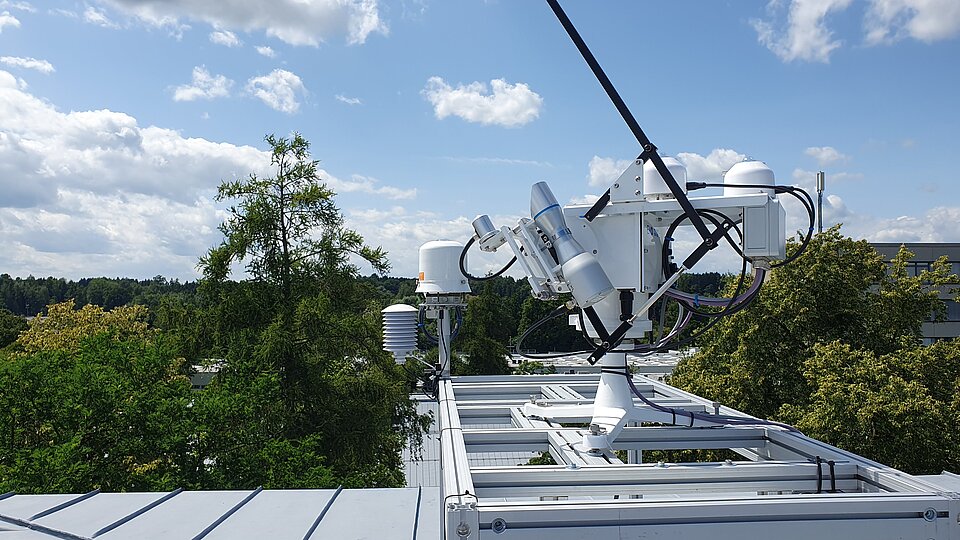
Solar energy plays a central role in the transition to a sustainable energy supply system. The Laboratory for Solar Energy Systems (LSE) at the Rosenheim Campus focuses on energy meteorology, photovoltaics, electricity grids, energy storage, solar thermal energy and district heating networks.
The focus is on the interactions between solar energy, weather conditions and technical system performance – from site analysis to long-term operational assessment. All work is underpinned by precise measurements and the analysis of meteorological variables relevant to energy. Using high-resolution sensors and long-term data sets, the laboratory quantifies the effects of weather on the performance of photovoltaic systems and translates these into realistic yield models. In the field of solar thermal energy, district heating networks and energy storage, the laboratory investigates modern solar thermal energy systems and how they can be optimised.
The Laboratory for Solar Energy Systems collaborates with various universities, companies and research partners. It therefore makes a scientifically sound, practice-oriented contribution to the sustainable transformation of the energy supply.
Further information on the Laboratory for Solar Energy Systems (LSE) is available here.
proto_lab – Interdisciplinary laboratory for a prototype production environment
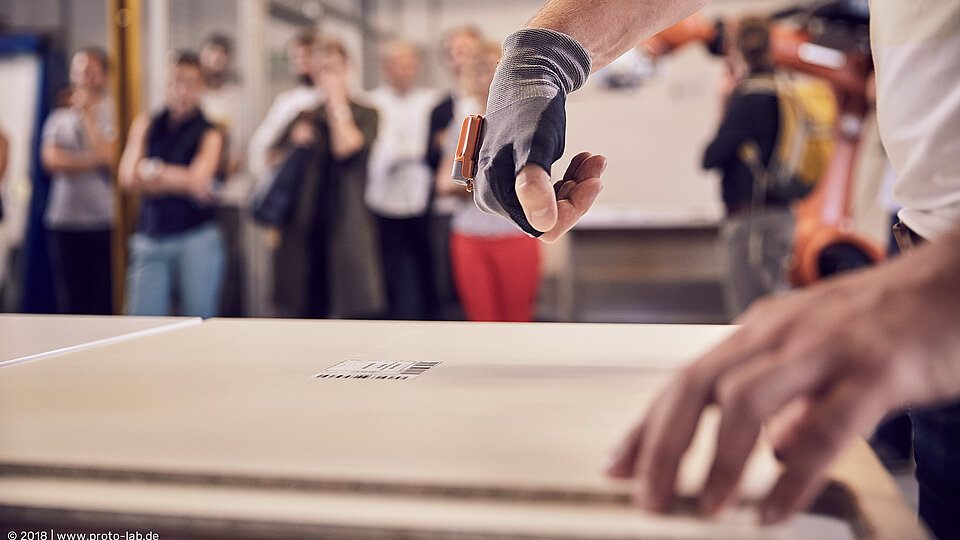
At proto_lab, we blend the adaptability of traditional craftsmanship with the effectiveness of modern industry. We use intelligent technology to enable people, machines, logistics, and products to communicate and collaborate with each other directly and in a decentralized manner. This approach allows us to efficiently react to individual customer's requirements.
We built a versatile Internet of Things (IoT) system designed specifically for the ongoing needs of Industry 4.0, using furniture production as our use case. Our model holistically takes care of all parts involved in fulfilling a customer order. It begins with receiving the order and planning for its production based on available capacity and scheduling. Then, it oversees the manufacturing and assembly of the furniture. Finally, it handles the delivery of the finished product to the customer.
The proto_lab primarily acts as a research hub, a teaching resource for the university, and a bridge for sharing knowledge between the university and the local business community.
RO-LIP – Rosenheim Laboratory for Interdisciplinary Projects
About the Lab
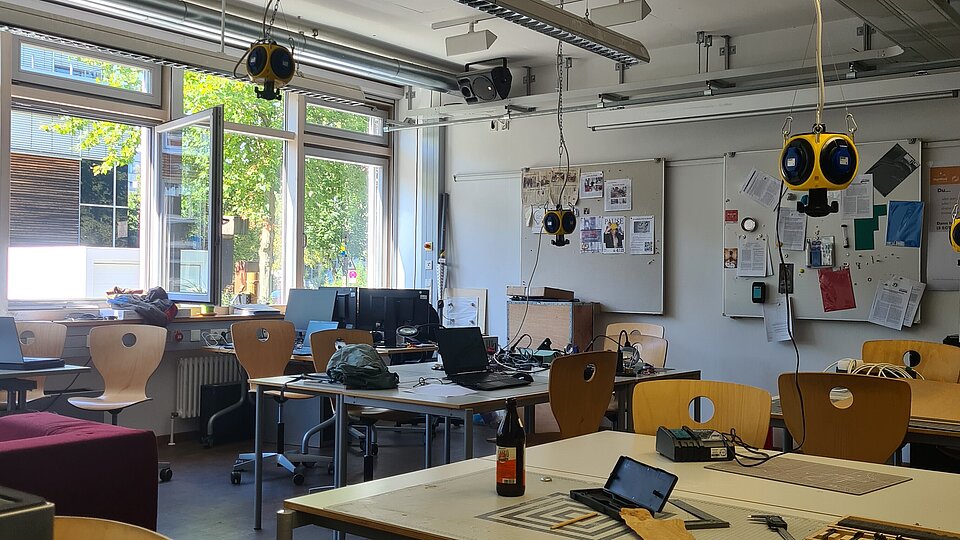
The RO-LIP, short for the Rosenheim Laboratory for Interdisciplinary Projects, is an open lab and workshop for students and staff at Rosenheim University of Applied Sciences. Here, you can give free rein to your ideas and exchange ideas with other students.
We offer events, workshops, projects, podcasts and much more for all students at the university.
Opening hours: Monday to Friday, 9.00 am to 5.00 pm
RO-LIP’s areas of focus are: supporting interdisciplinary collaboration, connecting students, providing a space for creativity, and promoting student-led projects
Facilities
- Wood and metalworking, electronics, 3D printing, textiles and design, laser cutter
- Working groups
- Sustainability (Nachhaltigkeitsstammtisch)
- Other: Electronic music, stock market get-together, open research meetings, board game evenings
You can find more information about RO-LIP here.
roteg – Rosenheim Technology Centre for Energy and Buildings
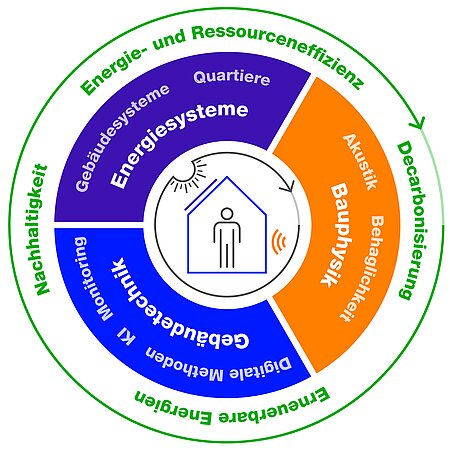
With its wide-ranging research areas, roteg sees itself as a competent and high-performing partner for interdisciplinary research and development projects undertaken by national and international companies in the fields of energy and building technology. Students on the affiliated degree programmes in Energy and Building Technology, Building Physics and other related subjects also benefit from the state-of-the-art laboratories and facilities.
Rosenheim Technical University of Applied Sciences aims to continuously expand the transfer of ideas, knowledge and technology with the business sector. In order to be a competent and high-performing partner for companies, a strategy has been developed which, amongst other things, provides for the expansion of the university’s laboratories. The foundation for this was laid by the Rosenheim Technology Centre for Energy and Buildings – roteg – whose construction began back in July 2016 and which was realised thanks to the generous support of the Seeon District, the Ministry of Agriculture and a grant of three million euros from the Free State of Bavaria. The funds were used for the construction, equipping and expansion of laboratories and test rigs for energy, solar and building technology at the new research centre. With around 800 m² of laboratory space, roteg offers innovative technology and optimal conditions for contract and collaborative projects, as well as for teaching.
Opportunities for collaboration with businesses
roteg supports businesses in the energy and building services engineering sectors as a research and development partner. In addition, roteg offers businesses the opportunity to take on students or to offer work-integrated dual degree programmes in the field of energy and building services engineering.
You can find more information about roteg here.
Centre for Circular Economy & Recycling in Waldkraiburg (ZKR)
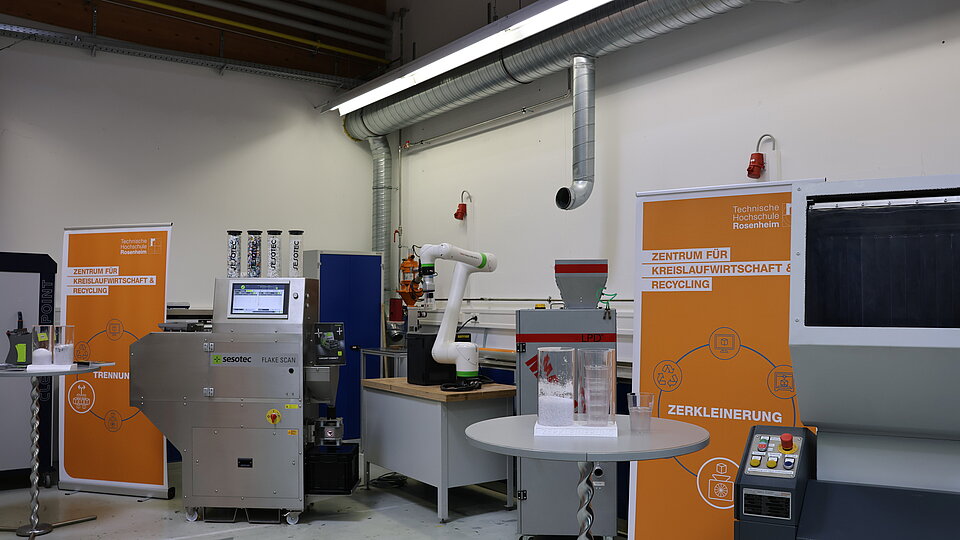
The Centre for Circular Economy & Recycling (ZKR), opened in 2026, serves as a central hub for companies across the German-speaking world seeking to make their products and processes circular, sustainable and, at the same time, more economically attractive. The initial focus will be on plastics, with other material groups such as wood, building materials and bio-based materials set to follow in the future.
Rethinking the entire cycle
The ZKR takes a holistic approach: from the development of sustainable business models through product design and manufacturing to recycling, life cycle assessment and economic feasibility analyses, the centre covers the entire value chain. The aim is to systematically further develop the established linear economic model and enable closed-loop material cycles.
“Through the circular economy, we can maintain our prosperity whilst ensuring intergenerational justice and independence,” emphasises Prof. Dr.-Ing. Johannes Eben, Head of the Centre for Circular Economy & Recycling. “At the ZKR, we aim to be the point of contact in the DACH region for all issues relating to the circular economy – from business models and product design through to technical implementation.”
To date, there are only a few comparable institutions in the German-speaking world. The ZKR is thus positioning itself as a strategically important research institution for the circular economy.
Tangible benefits for businesses
The ZKR is aimed at small and medium-sized enterprises, family-run businesses, large corporations and start-ups. Under the Open Lab model, infrastructure and scientific expertise are also available to address specific practical issues – such as the use of recycled materials and the optimisation of sorting and processing procedures.
You can find more information about the Centre for Circular Economy & Recycling (ZKR) here.

TH Rosenheim publishes its sustainability strategy
TH Rosenheim publishes its sustainability strategy
TH Rosenheim opens Centre for Circular Economy and Recycling
TH Rosenheim opens Centre for Circular Economy and RecyclingUN Sustainable Development Goals (SDGs)
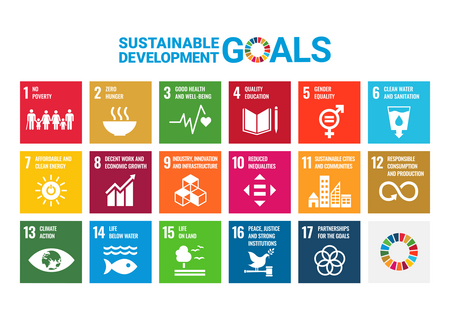
Through its research, Rosenheim Technical University of Applied Sciences supports the United Nations’ Sustainable Development Goals.
Climate Change Management Team
-

Dr. Bettina Ruth-Anneser
+49 (0)8031 / 805 - 2691 bettina.ruth-anneser@th-rosenheim.de
Project funding details
Project details
Title: KSI: Climate Protection Management for the Implementation of the Rosenheim University of Applied Sciences’ Integrated Climate Protection Concept – Follow-up Project (KSI: Klimaschutzmanagement zur Umsetzung des integrierten Klimaschutzkonzeptes der TH Rosenheim – Anschlussvorhaben)
Duration: 1 February 2023 – 31 July 2026
Implementing body: Rosenheim Technical University of Applied Sciences – Centre for Research, Development and Transfer (Technische Hochschule Rosenheim – Zentrum für Forschung, Entwicklung und Transfer)
Funding reference: 67K14067-1
Aim and content of the project: The proposed follow-up project aims to implement the key measures from the climate protection strategy and to institutionalise climate protection management at Rosenheim Technical University of Applied Sciences.
Project sponsor: www.klimaschutz.de/kommunalrichtlinie
National Climate Protection Initiative (NKI)
Through the National Climate Protection Initiative, the German Federal Government has been initiating and funding numerous projects since 2008 that contribute to reducing greenhouse gas emissions. Its programmes and projects cover a broad spectrum of climate protection activities: from the development of long-term strategies to practical support and investment-based funding measures. This diversity ensures a wealth of good ideas. The National Climate Protection Initiative helps to embed climate protection at a local level. It benefits consumers as well as businesses, local authorities and educational institutions.