
![[Translate to English:]](/fileadmin/_processed_/c/4/csm_medizintechnik-21x9_1cbf334b42.png "[Translate to English:]")
About the degree programme
Would you like to save lives through technology and help shape the future of medicine?
From simple bandages to smart implants and modern ultrasound devices to high-precision surgical robots: medical technology develops innovative solutions that improve diagnoses, support treatments, and enhance people’s quality of life.
Why should I study medical technology?
As a medical technology engineer, you’ll work at the intersection of medicine, technology, and computer science, bringing these fields together. You’ll learn to understand medical requirements and develop innovative products that support doctors in diagnosis and treatment.
Can I study medical technology at Rosenheim University of Applied Sciences with a practicum semester or as a dual-track program?
A unique feature of our university, TH Rosenheim, is that students can pursue their degree with practical training phases integrated throughout their studies or with a practical semester.
Dual Study Programs: Programs “with in-depth practical training” and collaborative study programs are available.
Course content

During the first two semesters, you’ll acquire the fundamental engineering knowledge in design, computer science, electrical engineering, as well as mathematics, physics, and chemistry. Starting in the third semester, you’ll delve into medical technology and study subjects such as anatomy, physiology, medical device engineering, and the development and manufacturing of medical devices.
As your studies progress, you’ll tailor your program through specialized elective modules and choose your areas of focus.

Program Structure
The bachelor’s program spans seven semesters. In the fifth semester, you’ll gain valuable professional experience during an 18-week internship at a medical technology company. Alternatively, you can complete the internship while continuing your studies—a flexible option that’s also suitable for a dual study program. The program culminates with a bachelor’s thesis in the seventh semester. In addition, you’ll gain insights into the economic, regulatory, and organizational aspects of medical technology, ensuring you’re well-prepared to enter the workforce.
Further documents
Career Opportunities
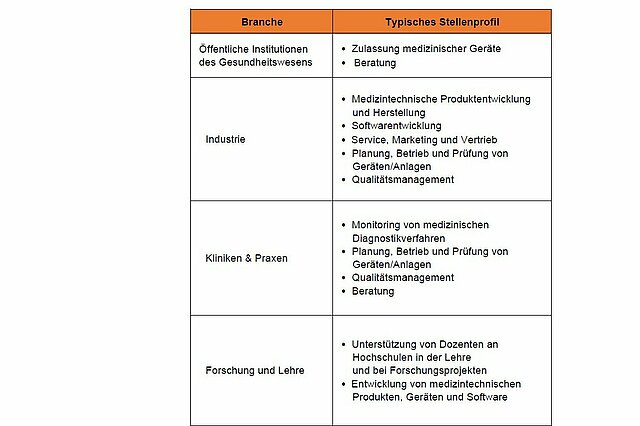
Career prospects for medical technology students
According to estimates by the Federal Ministry of Health, there are said to be around 400,000 different medical devices and new ones are being added every day. Examples are devices for diagnostics, surgery, intensive care, implants, sterilisation as well as dressings, aids or surgical material. At the moment, the industry is showing an annual growth rate of 6 percent. Therefore, the demand for medical technology engineers is very high and the job prospects are considered excellent.
Here is a small selection of possible fields of activity:
- Research and development of medical technology products and processes in industrial companies
- Approval of medical devices
- Quality management
- Research and teaching
- Installation, repair and maintenance of medical devices in practices and clinics
- Training and education of personnel on the function, use and maintenance of medical technology products
Further information on career opportunities after successfully completing the Bachelor's degree in medical technology
Application and admission
When can you apply for the degree programme?
- with an international university entrance qualification: 15 February - 15 July via uni-assist for a study start in October (winter semester)
- with a German university entrance qualification: 15 April - 15 July via TH Rosenheim application portal
How can you apply for the degree programme?
- Apply only via uni-assist if you have obtained your higher education entrance qualification outside Germany
- Apply via the TH Rosenheim online application portal if you have obtained your higher education entrance in Germany
Study requirement
The study of medical technology requires an internship, the so-called pre-study internship, of at least 12 weeks. As a rule, the preliminary internship must be completed prior to the degree programme, but at the latest by the time the student enters the fourth semester of study.
The training content of the preliminary practical training should cover at least one of the following areas:
- Basic craft training in metal: filing, drilling, milling, turning, welding, riveting, assembly and disassembly, maintenance, repair.
- Electrical engineering: soldering, wiring, measuring and testing.
- Medicine: Application, production and testing of medical technology products in medical facilities or in medical technology companies.
Upon application, students can have a professionally suitable completed vocational training or a relevant, predominantly related professional activity of at least twelve months recognised as prior practical experience, provided that the content and objective correspond to the educational objective and the educational content of the prior practical experience.
If a corresponding relevant activity completed prior to the degree programme lasts less than 12 months or if proof of a corresponding practical training is provided, a credit of up to a maximum of six weeks is possible.
Training plan for practical training (pdf)