

Networking and Knowledge Transfer in the Context of Sustainability
Rosenheim Technical University of Applied Sciences fosters collaborations and partnerships in the field of sustainability in order to join forces in shaping a fairer and greener future. Here we present some of these networks and partnerships.
Strategic objectives
- Sustainability for everyone – sharing knowledge across all sectors of society
- Regional and international networking in the field of sustainability
- Integrating sustainability considerations into all the activities of the Entrepreneurship Center ROCkET
DIVERSE – DIVERSE European University Alliance for Digital and Innovative Venture Science Education for Resilient and Sustainable Entrepreneurship


DIVERSE – Digital and Innovative Venture Science Education for Resilient and Sustainable Entrepreneurship
A key milestone on the path towards embedding social innovation within the institutional framework is the participation of Rosenheim University of Applied Sciences in the European university alliance DIVERSE – Digital and Innovative Venture Science Education for Resilient and Sustainable Entrepreneurship.
DIVERSE brings together twelve European universities from eleven countries. The aim of the alliance is to develop sustainable, inclusive and innovative solutions to societal challenges. The focus is on promoting practice-oriented and interdisciplinary teaching and research, as well as establishing a joint inter-university campus with flexible learning pathways. DIVERSE European University Alliance aims to train specialists who will make an active contribution to pressing issues in Europe, such as the circular economy, well-being and digital transformation. The project is led by Prof. Dr Carolin Fleischmann at Rosenheim University of Applied Sciences. In 2023, DIVERSE was awarded the European Commission’s Seal of Excellence.
You can find more information about DIVERSE here.
ezro - Energiezukunft Rosenheim (Rosenheim's Energy Future)

ezro – A partnership for the benefit of the environment
Founded in 2012, Energiezukunft Rosenheim (ezro) is a partnership between the City and County of Rosenheim, Rosenheim Technical University of Applied Sciences, and public, private-sector and individual stakeholders.
The initiative focuses on the areas of renewable energy, sustainability, agriculture, local development, e-mobility, energy cooperatives, and buildings and industry. It is aimed at local decision-makers, businesses, interested members of the public and potential investors in the energy transition.
Through numerous energy projects, regular specialist events on current topics and advisory services in the form of free energy consultations, we are driving forward the energy transition in the city and county of Rosenheim.
Objectives
- Networking between regional stakeholders
- Supporting the expansion of renewable energy
- Supporting the region on its path to climate neutrality
- Providing information for citizens, local authorities and businesses
- Sustainable use of energy and resources
The ezro members – A strong community
Members: Rosenheim Technical University of Applied Sciences, Rosenheim County, City of Rosenheim, Rosenheim Office for Food, Agriculture and Forestry (AELF), Bavarian Farmers’ Association, Bürgerenergie Chiemgau eG (BEC), Duschl Ingenieure, Euregio Inntal, GIH-Bayern e. V., Josef Huber, Mayor and Deputy County Administrator, Chamber of Commerce and Industry for Munich and Upper Bavaria, INNergie, Institute for Sustainable Energy Supply (INEV), Rosenheim County Craftsmen's Association, meine Volksbank Raiffeisenbank eG, Rosenheim Solar Promotion Association e.V., Sparkasse Rosenheim-Bad Aibling, Rosenheim Municipal Utilities, Bad Aibling Municipal Utilities, 1KOMMA5° GmbH
MINTnetz18+ for a strong new Generation of STEM Talent

Working together to foster talent for the future of south-east Bavaria
STEM subjects – that is, science, technology, engineering and mathematics – are still regarded as difficult. As a result, many pupils do not feel confident enough to study these subjects at university. At the same time, STEM careers play a significant role in addressing major societal challenges such as digitalisation and shaping the climate, energy and mobility transitions. Germany’s capacity for innovation, the safeguarding of prosperity and the maintenance of the country’s position as a centre of technological excellence depend to a considerable extent on skilled workers in STEM professions.
That is why Rosenheim Technical University of Applied Sciences works closely and collaboratively with businesses, schools, STEM stakeholders and the public sector to build key skills, secure a sustainable supply of the next generation of STEM professionals and strengthen the region. Through this cooperation, initiatives are created to inspire children, teenagers and young adults to take an interest in maths, computer science, natural sciences and technology. At the same time, concrete career prospects are highlighted – with the particular aim of sparking enthusiasm for STEM career paths. In the MINTregion18, a strong network is thus emerging that links education, business and the region, and specifically builds the key skills and the skilled workforce of tomorrow.
You can find more information about “MINTnetz18+” here.
You can find more information about STEM events here: www.mintregion18.de.
BayZeN - Bavarian Center for Sustainability in Higher Education (BayZeN)

In December 2023, Rosenheim University of Applied Sciences became a member of the Bavarian Centre for Sustainability in Higher Education (BayZeN).
BayZeN aims to improve the framework conditions for sustainability at and with Bavarian higher education institutions. From this overall objective, the following partial goals are deduced:
- BayZeN raises awareness and motivates, by encouraging academic debate about the grand challenges of society and sharpening the understanding of sustainability in the context of higher education and across all faculties.
- BayZeN connects people and organisations by offering a platform for exchange of knowledge, methods and good practice examples as well as by initiating and supporting subject-specific working groups.
- BayZeN creates transparency by informing about current developments and activities connected to sustainability at Bavarian higher education institutions.
- BayZeN advises by providing higher education institutions and policy makers with recommendations for action and supporting them with the implementation of sustainability.
Common Understanding and Vision for Sustainability
On the basis of a common understanding and vision for sustainability, the universities and universities of applied sciences pool their resources and cooperate with eachother in order to implement sustainability in the fields of research, teaching, operations, governance, knowledge transfer and student initiatives.
There are various working groups within BayZeN. The AG Klimaschutzmanagement (Climate Protection Management Working Group) is a forum for climate protection managers at Bavarian universities and colleges to exchange ideas. A meeting is held once a month.
Gründungshub Oberbayern: Effective support for business start-ups

Together with other higher education institutions and universities, Rosenheim Technical University of Applied Sciences is creating a new ecosystem for those interested in starting a business. The Upper Bavaria Start-up Hub, launched in 2025, brings together and expands existing services and programmes designed to promote entrepreneurship and start-ups. It is aimed at both students and academic staff. The aim is to train a new generation of entrepreneurs who not only approach innovative business ideas from an economic perspective, but also specifically address social and environmental challenges.
Mind Makers Masterclass
At its heart is the Mind Makers Masterclass, a two-semester, ECTS-accredited certificate programme that combines entrepreneurial thinking with sustainability and a focus on the common good. Students are not only equipped to set up traditional start-ups, but also develop solutions with social relevance – ranging from sustainable energy to social inclusion. The Hub sees itself as a real-world laboratory for sustainable entrepreneurship.
You can find out more about the Gründungshub Oberbayern here.
Centre for Circular Economy & Recycling in Waldkraiburg (ZKR)
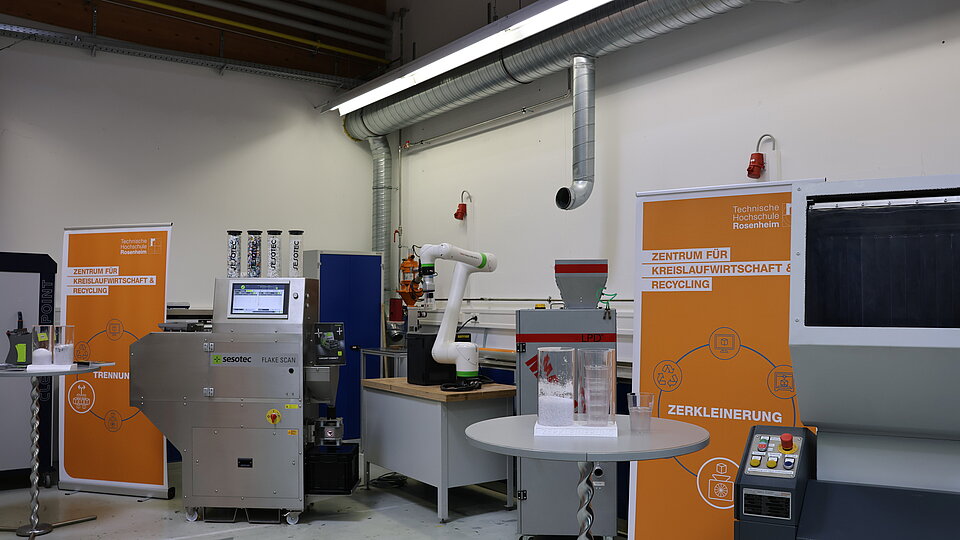
The Centre for Circular Economy & Recycling (ZKR), opened in 2026, serves as a central hub for companies across the German-speaking world that wish to make their products and processes circular, sustainable and, at the same time, more economically attractive. The initial focus is on plastics, with plans to expand to other material groups such as wood, building materials and bio-based materials in the future.
Rethinking the entire life cycle
The ZKR takes a holistic approach: from the development of sustainable business models, through product design and manufacturing, to recycling, life cycle assessment and cost-benefit analyses, the centre covers the entire value chain. The aim is to systematically further develop the established linear economic model and facilitate closed-loop material cycles.
“Circular Economy helps us to maintain our prosperity while ensuring intergenerational equity and independence,” emphasises Prof. Dr.-Ing. Johannes Eben, Head of the Centre for Circular Economy & Recycling. “At the ZKR, we aim to be the point of contact in the DACH region for all matters relating to the circular economy – from business models and product design right through to technical implementation.”
To date, there are only a few comparable institutions in German-speaking countries. The ZKR is thus positioning itself as a strategically important research institution for the circular economy.
Tangible benefits for businesses
The ZKR is aimed at small and medium-sized enterprises, family-run businesses, large corporations and start-ups. Under the Open Lab model, infrastructure and scientific expertise are also available to address specific practical issues – such as the use of recycled materials and the optimisation of sorting and processing procedures.
You can find more information about the Centre for Circular Economy & Recycling here.
Children's Universities

Children’s universities open the door to the world of STEM for young people and make future-oriented skills visible and tangible for everyone
Since autumn 2023, TH Rosenheim has been running the Children’s University, a programme for children aged between seven and twelve who wish to immerse themselves in the fascinating world of science on three afternoons each semester. The initiator and director of the Children’s University is Professor Nicole Strübbe from the Faculty of Engineering.
How sustainable is plastic really? How do plants communicate with one another? Why do the stars shine at night, and how does an aeroplane actually work? Anyone who looks around carefully in everyday life will find many exciting mysteries. At the Children’s University, the professors at Rosenheim University of Applied Sciences provide answers to some of these questions, which they themselves are researching. After the talk, the children have the opportunity to take on the role of researchers themselves and carry out experiments in the laboratory under the guidance of the scientists.
It is important to encourage girls to take part in STEM subjects. This can be achieved through targeted educational initiatives, raising awareness of gender equality, promoting role models and creating an inclusive learning environment. By breaking down barriers and encouraging girls to explore their interests and abilities in STEM subjects, we can help to reduce gender inequality in these fields. This is precisely where the Children’s University comes in, by opening up new perspectives and encouraging girls to engage with STEM topics.
You can find more information about the Children’s University at Rosenheim Technical University of Applied Sciences here.
Climate Advisory Board of Rosenheim Technical University of Applied Sciences

At Rosenheim Technical University of Applied Sciences, there are various ways to discuss and collaborate on the topic of sustainability.
The Climate Advisory Board is a working group that facilitates discussion and collaboration on sustainability at Rosenheim University of Applied Sciences. It comprises professors, representatives from Facility Management, the Data Centre, the Finance Department and Climate Protection Management, as well as one representative each from the PhD students and undergraduates. The Climate Advisory Board meets twice a year.
Student involvement in sustainability
At Rosenheim Technical University of Applied Sciences, there is:
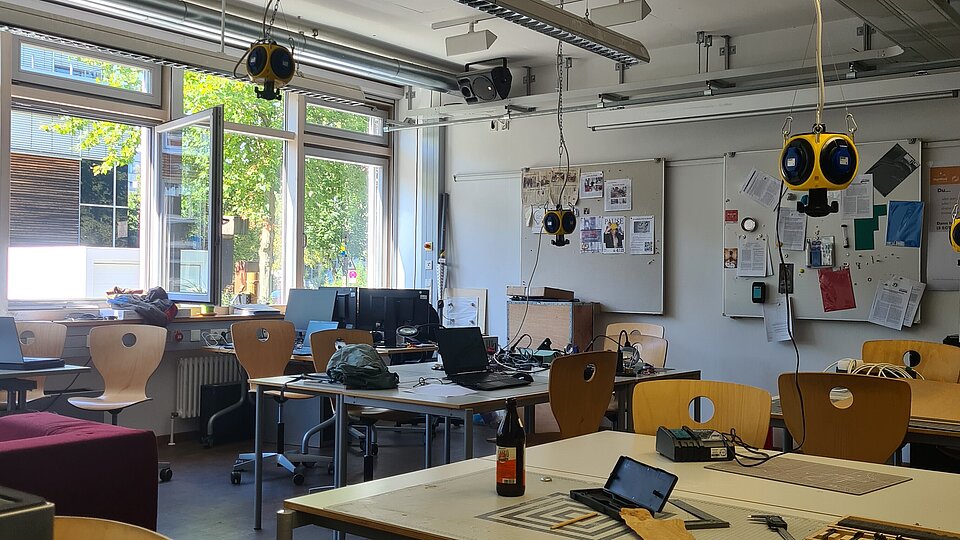
- RO-LIP, the Rosenheim Laboratory for Interdisciplinary Projects, is an open laboratory and workshop for students and staff at Rosenheim Technical University of Applied Sciences. Here, you can give free rein to your ideas and exchange views with other students.
- The Student Council (StuVe) actively champions students’ interests at university and faculty level. We help shape university life and represent you in financial, academic and social matters. In addition to the officially elected positions, there are also many voluntary roles in which students can play an active part. Do pop in and get to know us!
Would you like to find out more about student initiatives and student engagement in sustainability at TH Rosenheim? Then visit our information page “Student Engagement in Sustainability”.

DIVERSE Alliance strengthens international cooperation at network meeting in Finland
DIVERSE Alliance strengthens international cooperation at network meeting in Finland
DIVERSE European University Alliance: Europe’s Diversity at TH Rosenheim
DIVERSE European University Alliance: Europe’s Diversity at TH Rosenheim
DIVERSE Alliance: TH Rosenheim sends a strong signal in favour of European cooperation
DIVERSE Alliance: TH Rosenheim sends a strong signal in favour of European cooperation
Climate Change Management Team
-

Dr. Bettina Ruth-Anneser
+49 (0)8031 / 805 - 2691 bettina.ruth-anneser@th-rosenheim.de
Project information
Project details
Title: KSI: Climate Protection Management for the Implementation of the Rosenheim University of Applied Sciences’ Integrated Climate Protection Concept – Follow-up Project (KSI: Klimaschutzmanagement zur Umsetzung des integrierten Klimaschutzkonzeptes der TH Rosenheim – Anschlussvorhaben)
Duration: 1 February 2023 – 31 July 2026
Implementing body: Rosenheim Technical University of Applied Sciences – Centre for Research, Development and Transfer (Technische Hochschule Rosenheim – Zentrum für Forschung, Entwicklung und Transfer)
Funding reference: 67K14067-1
Aim and content of the project: The proposed follow-up project aims to implement the key measures from the climate protection strategy and to institutionalise climate protection management at Rosenheim Technical University of Applied Sciences.
Project sponsor: www.klimaschutz.de/kommunalrichtlinie
National Climate Protection Initiative (NKI)
Through the National Climate Protection Initiative, the German Federal Government has been initiating and funding numerous projects since 2008 that contribute to reducing greenhouse gas emissions. Its programmes and projects cover a broad spectrum of climate protection activities: from the development of long-term strategies to practical support and investment-based funding measures. This diversity ensures a wealth of good ideas. The National Climate Protection Initiative helps to embed climate protection at a local level. It benefits consumers as well as businesses, local authorities and educational institutions.